
Screen time and Freddie · Last checked November 2026
Little ones need people, play and sleep far more than any app
"As a GP, parents ask me about screens all the time. As a dad, I had the same worry. The honest answer is that young children need people, play and sleep far more than they need any app, including mine. So I built Freddie to sit inside the advice, not to argue with it."
James, GP and Freddie's dad


What the guidance says
In March 2026 the UK government published its first screen time guidance for children under five, based on an independent review of the evidence by paediatricians, health visitors and early-years experts. In short:
Under 2
Avoid screens, except shared moments
Things that build bonding and conversation, like video calls with family or looking through photos together.
2 to 5
About an hour a day, or less
Slow-paced content made for young children, with simple stories and clear, unhurried voices.
Every age
Less is better, and together is best
Watch and talk together. No screens in bedrooms, at meals or in the hour before bed, no background TV, and no AI toys or chatbots for now.
The World Health Organization (2019) and the American Academy of Pediatrics give similar advice. The guidance also recognises that children with SEND may need a tailored approach, and that assistive technology isn't counted in the same way.

How Freddie answers each point
Every feature was checked against one question: would I be happy for my own son to use this?
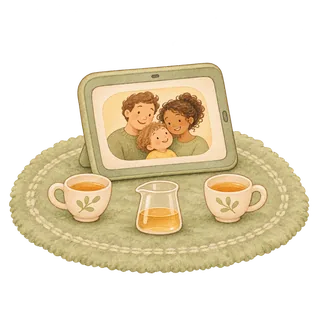
The guidance says
Under 2s: only shared screen time
Freddie: Together Mode is on by default for under-2s, and Family photos with your own voice work like a photo album you look at together.
The guidance says
About an hour a day, or less
Freddie: A session timer and a daily allowance, set from your child’s age, ending with a gentle goodbye and an off-screen idea.

The guidance says
Slow-paced, made for little ones
Freddie: Still paintings, one sound per tap, no animation, no scene changes, and nothing that plays by itself.
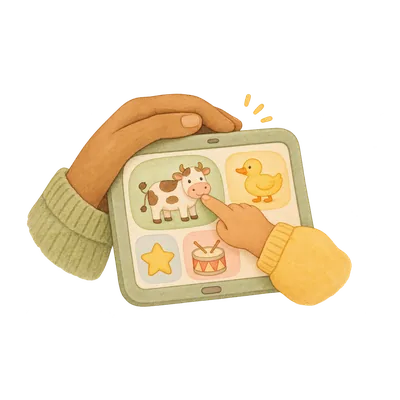
The guidance says
Watch and talk together
Freddie: Together prompts like “Where’s the cow? What does it say?”, fill-the-gap songs and copy-me actions.

The guidance says
No screens before bed or in bedrooms
Freddie: Quiet hours with a sleeping moon, and Listen mode dims the screen so only the sound plays.

The guidance says
Avoid AI toys and chatbots
Freddie: No chatbot, nothing that talks back, and no AI inside the app.
The guidance says
Use parental controls
Freddie: Every setting sits behind a grown-up gate, and the app can stay pinned so little fingers can’t wander off.

The guidance says
SEND: a tailored approach
Freddie: Routine and feelings boards, sensory presets, one-screen mode, and your own voice on every button.

The guidance says
Grown-ups’ phones matter too
Freddie: Freddie is built to be put down: short sessions, no notifications, nothing pulling either of you back.
What Freddie doesn't claim
Freddie won't make your child cleverer, and no app can replace you. We don't call it educational, we don't call it "good screen time", and we'll never show you a made-up statistic.
What we can promise is that when a screen is in the room, this one is calm, short, shared and yours.

Sources
- Screen time for under-5s, Best Start in Life (Department for Education and Department of Health and Social Care), March 2026
- Screen use by children aged under 5: independent report, Early Years Screen Time Advisory Group, March 2026
- Guidelines on physical activity, sedentary behaviour and sleep for children under 5 years of age, World Health Organization, 2019
- The health impacts of screen time: a guide for clinicians and parents, Royal College of Paediatrics and Child Health, 2019
- Media and Young Minds, American Academy of Pediatrics, 2016